
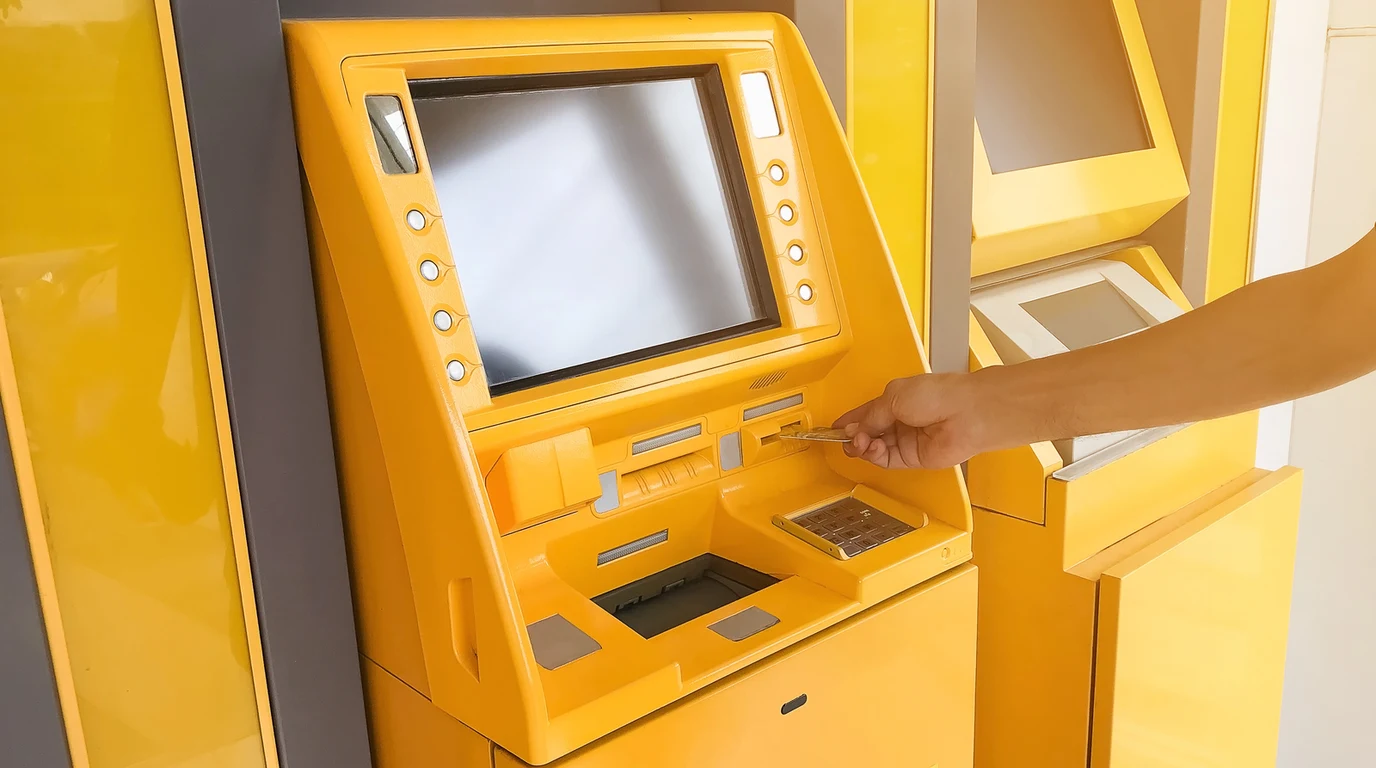
We have all been there. You are rushing to catch a streetcar or meet a friend for dinner, you duck into a corner store for a twenty-dollar bill, and you watch helplessly as the screen flashes a warning: *A convenience fee of $3.50 will be charged for this transaction.*
You accept it because you are in a rush. What you might not realize is that when you hit ‘yes’, you are often walking straight into a double-dip financial trap. When you use an out-of-network ATM in Canada, you aren’t just paying the machine owner; you are very likely paying your own bank a penalty for having the audacity to use someone else’s hardware. Over a year of casual weekend withdrawals, concert tickets, and farmers’ market trips, these minor paper cuts quietly bleed hundreds of dollars out of your hard-earned savings. Let’s fix that right now.
The nuance that trips people up is the assumption that holding a premium chequing account shields you from third-party operator fees. It does not. Even if your bank waives its internal $2.00 out-of-network charge because you keep a $4,000 minimum balance, the independent ATM owner in the subway station will still extract their $3.00 convenience fee. Your bank’s fee waiver only covers their side of the ledger.
## What Are the Best Alternatives to Paying ATM Surcharges?
If you want to stop lighting money on fire every time you need cash, you need to exploit the structural loopholes built into Canada’s banking system. There are three primary ways to completely sidestep these costs.
First, lean heavily on alternative shared networks. If you bank with a credit union, National Bank, Laurentian Bank, or Manulife Bank, you have access to The EXCHANGE Network. This cooperative alliance connects over 3,300 ATMs nationwide where members can withdraw cash without paying a single cent in surcharges. A credit union member in downtown Vancouver can use a partner credit union’s machine in downtown Halifax as if it were their home branch.
Second, consider modern digital banks that rewrite the rules. Institutions like EQ Bank have completely disrupted the traditional bricks-and-mortar model. Because they do not spend billions maintaining physical branch networks and proprietary ATM fleets, they pass those savings on to you—often by automatically reimbursing the domestic ATM operator fees you incur across Canada.
Third, use the grocery store loophole. The absolute best zero-fee cash workaround in Canada is hiding in plain sight at your local supermarket, pharmacy, or big-box retailer. When you pay for your groceries using your debit card, the terminal will prompt you to authorize a purchase. Nearly all major grocery chains (including Loblaws, Sobeys, Metro, and Walmart) allow you to request up to $50 or $100 in cash back directly from the till completely free of charge. You skip the sketchy third-party machine in the parking lot, you avoid the bank penalty, and you get your cash while picking up milk.
## How Do I Set Up a Zero-Fee Cash Management Strategy Today?
Eliminating these nuisance fees requires a shift from reactive panic to proactive planning. When you need cash urgently, you make expensive mistakes. Build this simple, three-step operational playbook into your weekly routine to ensure you never pay another ATM fee.
1. Audit Your Current Account and Map Your Ecosystem: Open your online banking portal today and check the fine print of your chequing account. Note where your bank’s closest physical terminals are located relative to your commute, your workplace, and your home. If you regularly travel through areas poorly serviced by your bank’s footprint, consider shifting your daily banking to a provider that offers fee reimbursements or joining a local credit union tied into The EXCHANGE Network.
2. Adopt the Grocery Store Cash Habit: Stop making dedicated trips to freestanding ATMs. Whenever you do your routine grocery shopping or run household errands, make it standard operating procedure to pull $40 or $50 in cash back right at the checkout counter. It costs zero dollars, requires zero detours, and normalizes small-denomination cash flow without triggering banking fees.
3. Keep a Emergency Buffer at Home: The primary driver of out-of-network ATM use is acute panic—realizing you need cash right now for a parking lot, a cash-only tip, or a garage sale. Keep a modest cash reserve (say, $100 in twenty-dollar bills) stored safely in your home. Replenish it exclusively through your bank’s own branded ATMs or via grocery cash-back during your normal routines. By decoupling your cash needs from urgent timelines, you take away the ATM operator’s leverage and keep your money where it belongs: in your own pocket.
***
### Frequently Asked Questions
Can I get cash back at any retail store in Canada without paying a fee?
Most major Canadian grocery chains, pharmacies (like Shoppers Drug Mart), and mass merchandisers (like Walmart) allow debit cash-back completely free of charge when you make a purchase. However, independent convenience stores or gas station kiosks sometimes charge small merchant-side fees for cash-back, so always check the PIN pad prompt before confirming the transaction.
Do digital-only banks in Canada offer access to physical cash?
Yes. While digital banks like EQ Bank do not maintain proprietary networks of branded ATMs, they issue standard debit cards that work on national and international networks like Interac and Cirrus. Many of these modern institutions fully reimburse the domestic ATM operator fees charged by third-party machine owners.
Why do credit union ATMs not charge surcharges to other credit union members?
Participating institutions belong to cooperative alliances such as The EXCHANGE Network. These networks allow member institutions to pool their physical infrastructure costs. Because the back-end routing and settlement agreements are shared cooperatively among member credit unions and select banks, they waive the terminal convenience fees for each other’s customers.
Direct Practical Verdict:
## Why Does My Bank Charge Me Extra to Use Another ATM?
To understand how the system extracts money from your account, you have to look under the hood of Canada’s interbank routing architecture. When you slide your debit card into an automated teller machine that does not bear your institution’s logo, you trigger a complex handshake across national clearing networks like Interac.
Your own bank looks at that transaction and views it as an administrative burden. To discourage you from leaving their ecosystem, they levy what is formally known as a Non-Network Fee (often ranging from $1.50 to $2.50 per withdrawal). Meanwhile, the independent or white-label operator who owns the physical box sitting in that gas station, bar, or convenience store needs to pay for the hardware, cash replenishment, security, and leasing space. They recoup those costs by slapping on a Convenience Fee (typically $2.50 to $5.00).
Combine the two, and a simple twenty-dollar cash withdrawal can cost you up to $7.50 in pure friction. That is a 37.5% penalty just to access your own money. It is an absurd wealth transfer from everyday consumers to institutional balance sheets, and the industry quietly collects hundreds of millions of dollars annually from people who simply needed a bit of folding paper.
## How Much Do Canada’s Big Banks Actually Charge for ATM Fees?
If you bank with one of Canada’s major financial institutions, your baseline costs are remarkably standardized—and punishing. Most entry-level or mid-tier chequing accounts include a set number of “free” transactions, but these almost universally apply only to their branded ATMs. Step outside the safety of that branding, and the meter starts running instantly.
Let us look at the structural reality of what happens when you wander off the reservation. The following matrix breaks down how major Canadian institutions and alternative providers handle these transactions so you can see exactly where your money is going.
To completely eliminate Canadian ATM fees, bypass proprietary bank networks by switching to institutions offering full fee reimbursements (like EQ Bank), utilizing alternative shared cooperatives like The EXCHANGE Network, requesting cash-back at grocery checkouts for zero cost, or exclusively planning cash needs ahead using your primary bank’s app locator.
| Financial Institution | Own-Network ATM Cost | Interac / Domestic Out-of-Network Fee | International ATM Fee | Key Fee-Saving Workaround |
|---|---|---|---|---|
| Royal Bank of Canada (RBC) | Free (select accounts) | $2.00 to $2.50 + operator fee | $5.00 + 3% currency conversion | Use RBC branch locators or premium tiered accounts. |
| Toronto-Dominion Bank (TD) | Free (select accounts) | $2.00 to $2.50 + operator fee | $5.00 + 3.5% currency conversion | Maintain minimum balance to waive monthly fees. |
| Scotiabank | Free (Global ATM Alliance) | $2.00 to $2.50 + operator fee | $5.00 international (Free via partner banks) | Leverage Global ATM Alliance partners when traveling. |
| EQ Bank | No proprietary ATMs | Fully reimbursed across Canada | Varies by network | Use any Canadian ATM; operator fees are refunded. |
| Credit Unions (EXCHANGE Network) | Free across 3,300+ terminals | Standard Interac rates apply | Varies by credit union | Download the EXCHANGE app to find surcharge-free terminals. |
Banking Cost Control & Consumer Financial Rights
Eliminating recurring financial institution surcharges protects hard-earned household capital. For ATM network fee avoidance and out-of-network charge prevention, explore our masterclass on Canada Bank Fee Rebates: Minimum Balance Account Math.